Power and electrical skids
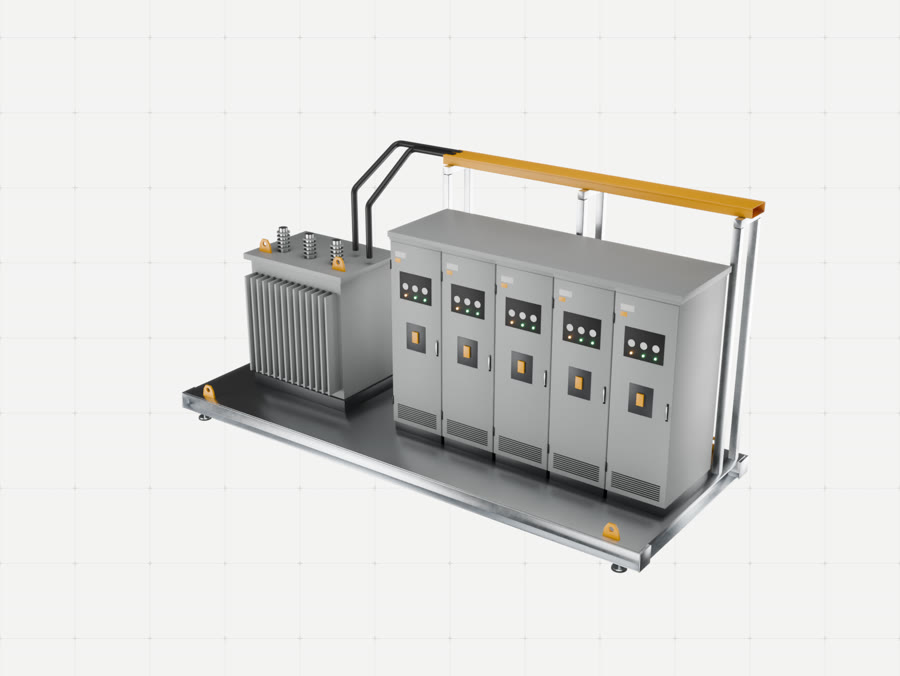
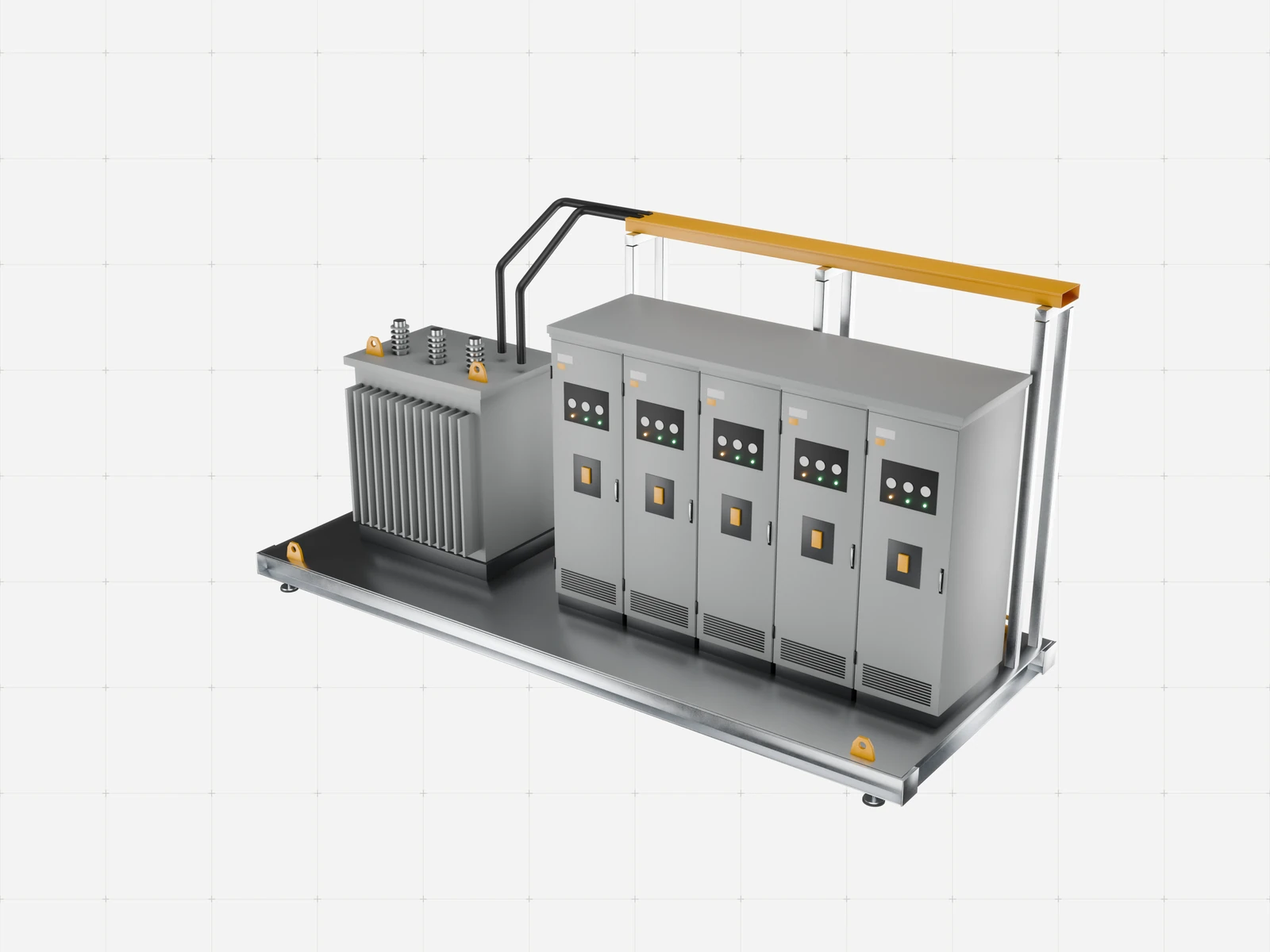
A power skid is a steel base that carries a transformer, switchgear, a UPS or a combination of them as one liftable unit.
The electrical skid is built and fitted out off site, then set on its pad and connected, so the power train arrives on the day the hall is ready for it.
Send drawingsProposed range. The scope is confirmed in the quote. Images are rendered models.
01 — Frame
What we fabricate
Electrical equipment is heavy in small spots and sensitive to a twisted floor. The frame is built around that.
- Base frame
- Longitudinal beams under the line of the equipment, with cross members where the feet land.
- Mounting rails
- Flat, drilled rails or channels that match the hole pattern of each cabinet, so a lineup of switchgear bolts down without shimming every section.
- Cable entry
- Openings and gland plate frames under the cabinets, and room under the deck for the bend of the largest cable.
- Deck
- Chequer plate or grating where people stand, removable where cables are pulled.
- Earthing
- Bonding points welded to the frame at both ends, and continuity across bolted joints.
- Lifting and transport
- Lugs placed for a load that is far heavier at the transformer end, and bracing that holds tall cabinets upright on the road.
02 — Placement
Where it goes
- In the power room
- UPS, switchboards and distribution on a common base, set in a row beside the data hall.
- In the yard
- Transformer and medium-voltage switchgear outdoors, often under a canopy or inside an enclosure.
- As a complete power train
- Transformer, switchgear and UPS on one skid, or on two that are bolted together on site. The longer the skid, the more the lifting plan and the stiffness decide the design.
03 — Specify
What to specify for a power skid
- Equipment footprint
- Base drawing of each cabinet with hole pattern and weight.
- Why it mattersThe mounting rails are drilled to it, and one wrong pattern stops the installation.
- Point loads
- Weight at each foot, and the heaviest single item.
- Why it mattersA transformer puts most of the load on a small part of the frame.
- Flatness
- The tolerance the switchgear maker gives for the mounting surface.
- Why it mattersDraw-out breakers and bus joints do not line up on a twisted base.
- Cable entry
- Top or bottom entry, cable sizes and bending radius.
- Why it mattersBottom entry sets the height of the frame and the openings in the deck.
- Clearances
- Front and rear working space and door swing.
- Why it mattersThe deck must be wide enough to work at the equipment safely.
- Transformer type
- Dry-type or liquid-filled, and oil volume.
- Why it mattersLiquid-filled units need containment, and it adds height and weight.
- Lifting
- Crane or jack-and-skate, and the route to the pad.
- Why it mattersDecides lug positions, jacking points and whether skates must fit under the frame.
- Environment
- Indoor, outdoor or coastal.
- Why it mattersSets the finish, and whether water must drain off the deck.
- Earthing
- Number and position of bonding points.
- Why it mattersThey are welded on in the shop, not added on site.
- Scope
- Steel only, or with equipment set and wired.
- Why it mattersDecides who lands the cabinets and who signs for the alignment.
04 — Checks
Checked before it leaves the shop
- Hole patterns
- Checked against the equipment drawings, cabinet by cabinet.
- Flatness
- The mounting rails are measured over the full length, and the readings are recorded.
- Dimensions and diagonals
- The frame is measured, with the position of the anchor points.
- Earth continuity
- Checked across bolted joints.
- Surface treatment
- Checked for thickness, with the readings in the documentation.
- Lifting lugs
- Marked with the lifting weight for the frame with equipment mounted.
05 — Scope
Steel only, or the complete skid
You choose how much is done before it leaves the shop.
- Level 01
Steel
Frame fabricated to your drawings, with lift points and surface treatment.
- Level 02
Mounted
Your equipment set and aligned on the frame.
- Level 03
Piped and wired
Piping, cable routes and connections completed in the shop.
- Level 04
Tested
Factory acceptance test with documentation before transport.
How it works
06 — Process- 01
You send drawings or a scope.
- 02
We reply within 24 hours.
- 03
You get a fixed price and a delivery date.
- 04
The workshop builds, and you can inspect before shipping.
- 05
The unit travels to site by road, braced for transport.
- 06
One lift onto the pad, ready to anchor and connect.
Send drawings
24 h replyDrawings, a sketch or a scope. Send what you have and we reply within 24 hours.
Send drawings07 — FAQ
Questions
What is a power skid?
A power skid is a steel base frame with electrical equipment mounted on it, usually a transformer, switchgear and distribution, sometimes with a UPS. It is assembled and wired in a shop, delivered as one unit and connected on site, which shortens the electrical work at the data center.
What is the difference between a power skid and an e-house?
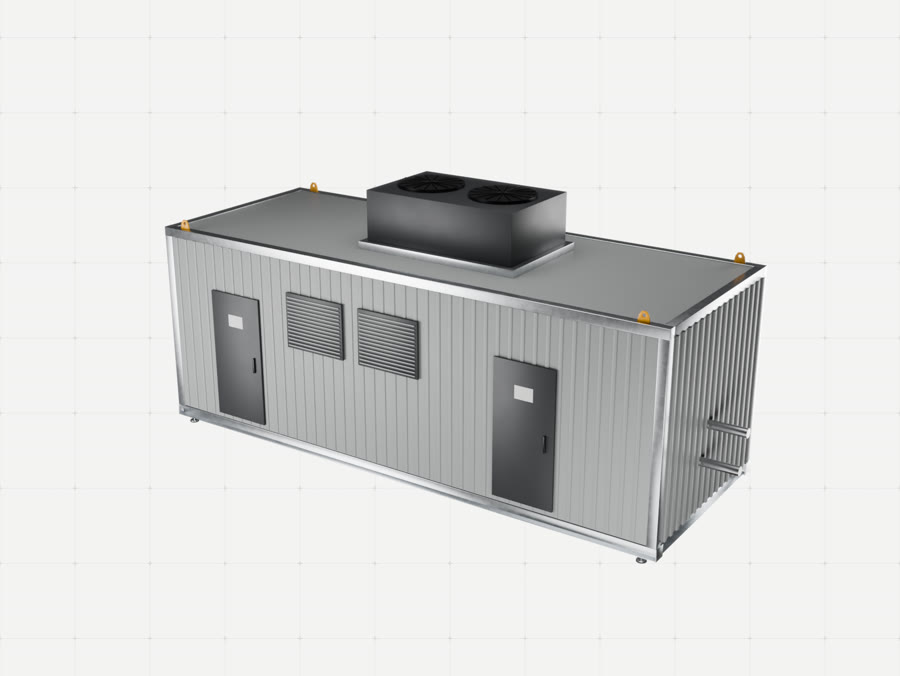
A power skid is open. It stands inside a building or under a canopy, and the building protects the equipment. An e-house is the same equipment inside its own steel enclosure with walls, roof, cooling and fire protection, so it can stand outdoors on its own.
How flat does the frame have to be?
As flat as the equipment maker requires, and that figure belongs in the order. Switchgear lineups are the strictest. We measure the mounting rails after welding and surface treatment, and the record follows the skid.
More in the range