01
Why data centers are built here
Operators come to the Nordic countries for things that are hard to find in one place: power that is mostly renewable, a cool climate and stable conditions. Norway's energy regulator, NVE, lists a high share of renewable power, relatively low power prices, a cool climate and political stability as the reasons the country attracts data centers.
Growth is fast. NVE reports more than 100 registered data centers in Norway and expects their electricity use to grow from 3 TWh in 2025 to around 8 TWh in 2030. The grid operators in Sweden and Finland and the Danish climate projection point the same way.
For the people who build them, that means a lot of power and cooling plant to set in a short time, much of it outdoors. That is where prefabricated skids, pipe racks and platforms earn their place.
02
Norway
Hydropower makes up about 88 percent of Norway's power supply.
Data center operators have had to register with the communications authority, Nkom, since January 2025. It is a registration, not a license. Anyone planning a data center with more than 2 MW of supplied electrical power must analyze how the surplus heat can be used, and since April 1, 2025, NVE must approve that analysis before construction starts.
On the road, the normal maximum vehicle width is 2.55 m. Wider units travel under the rules for special transport.
Data centers in Norway: who is building03
Sweden
In 2025, hydropower gave 42.4 percent of Sweden's electricity, nuclear 27.9 percent and wind 24.3 percent, according to the grid operator, Svenska kraftnät.
Svenska kraftnät puts the electricity use of data centers today at 3 TWh a year. Its scenarios for 2050 run from 9 to 41 TWh. They are scenarios, not forecasts.
The normal maximum vehicle width is 2.60 m. An indivisible load up to 3.50 m wide can travel under general regulations, and anything wider always needs an exemption from the road authority.
04
Denmark
Electricity from renewable sources covered 75.6 percent of Denmark's domestic electricity supply in 2025. Wind alone gave 47.8 percent.
The government's climate projection for 2026 expects data centers to use about 4.6 TWh of electricity a year toward 2030 and about 13 TWh by 2050.
A vehicle may be 2.55 m wide and 4.00 m high. Trucks, buses and their trailers may be 4.10 m high.
05
Finland
In 2024, 57 percent of Finland's electricity was produced from renewable sources. With nuclear power included, 95 percent was fossil-free.
In the grid operator Fingrid's scenarios, the electricity use of data centers rises from about 2 TWh in 2025 to between 9 and 18 TWh by 2030.
Vehicles from the EU and EEA may be up to 2.60 m wide and 4.40 m high in normal traffic.
06
What Nordic sites ask of the steel
Snow is the first thing that sets a Nordic site apart. In Norway the snow load on the ground is given for each municipality. Standards Norway's examples run from 150 kg per square meter in Stavanger to 750 in Namskogan, with Oslo at 350 and Tromsø at 600. The same platform is a different structure in each of those places.
Plant that stands outdoors lives with rain, salt air and long winters. Outdoor steel is normally hot-dip galvanized to EN ISO 1461, and sites at the coast need the heavier protection.
The road sets the size of each piece. Normal vehicle width is 2.55 m in Norway and Denmark and 2.60 m in Sweden and Finland. That decides where a skid, a rack section or a module is split.
- Where the site is
- It gives the wind and the snow for everything that stands outdoors.
- Indoors, outdoors or at the coast
- It sets the finish, and whether water must drain off the deck.
- The route to site
- It sets the largest unit we can build in one piece.
07
What we build for Nordic data centers
We build the steel that carries power and cooling equipment, to your drawings, in Norway.
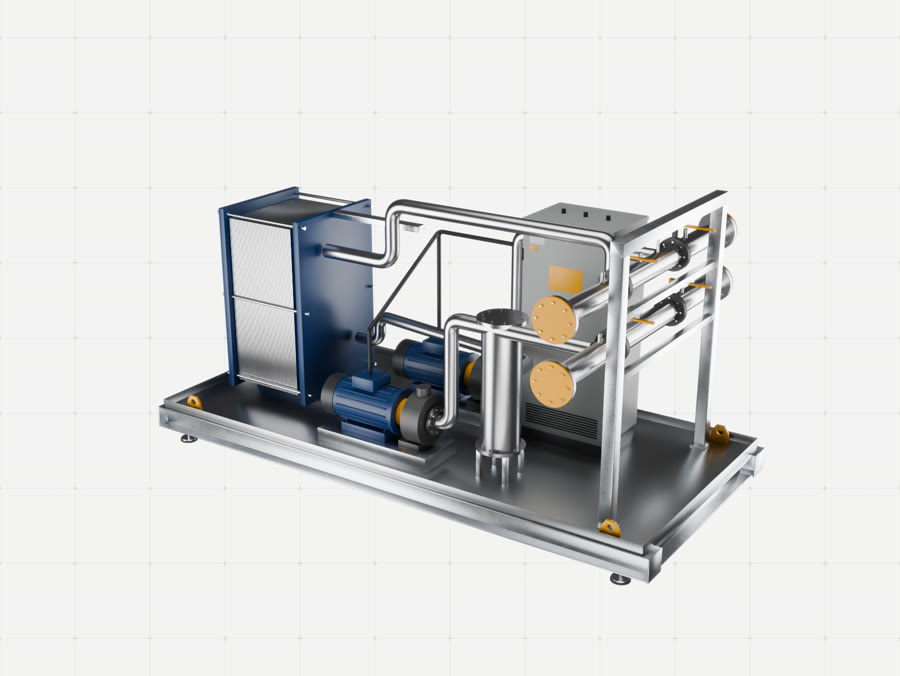
- Pump and CDU skids
- Frames for coolant distribution units, pumps, heat exchangers and manifolds, with leveling and drip containment.
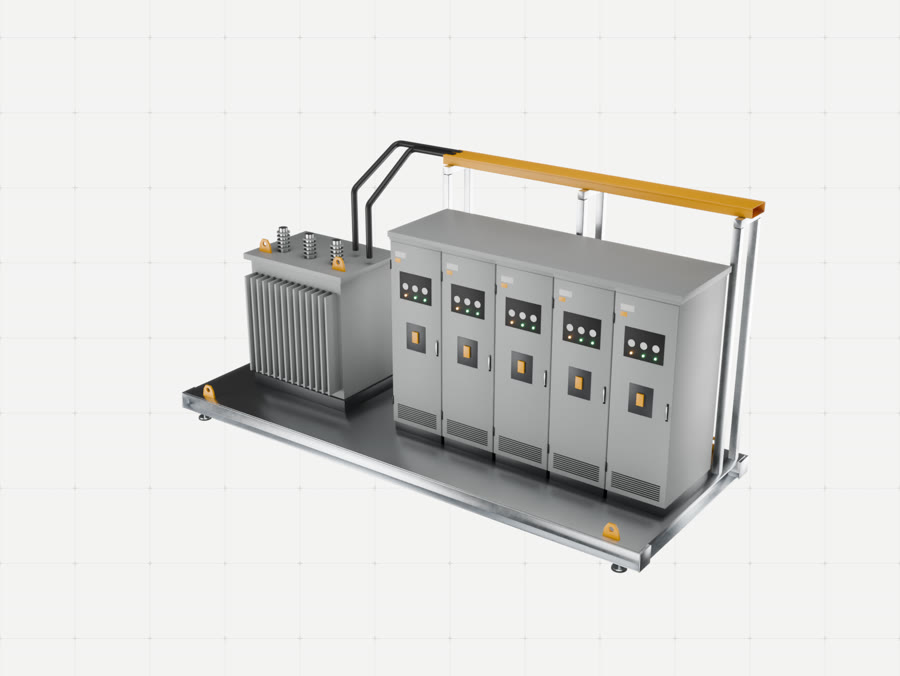
- Power and electrical skids
- Steel bases that carry a transformer, switchgear or UPS block as one liftable unit.
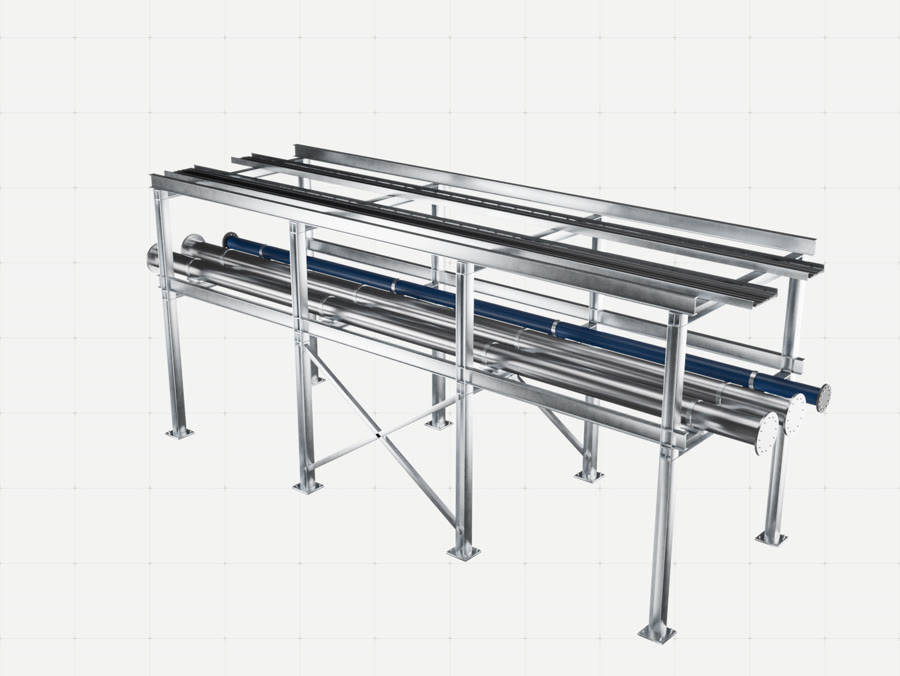
- Pipe racks and pipe supports
- Repeatable racks, supports and bracing for piping and cable routes.
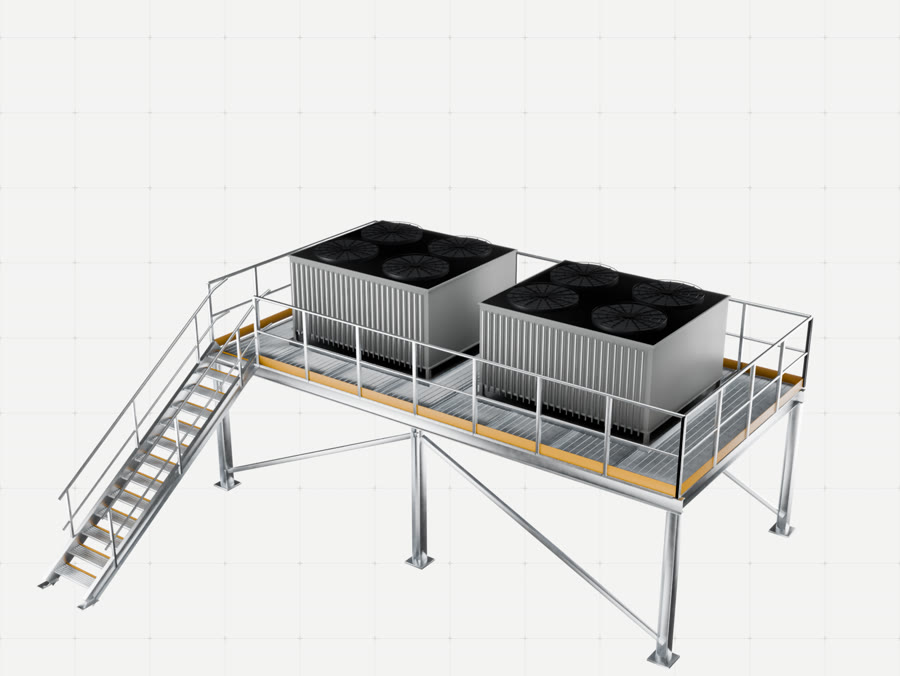
- Equipment platforms and gantries
- Roof and yard steel for chillers and dry coolers, with grating, handrail and access.
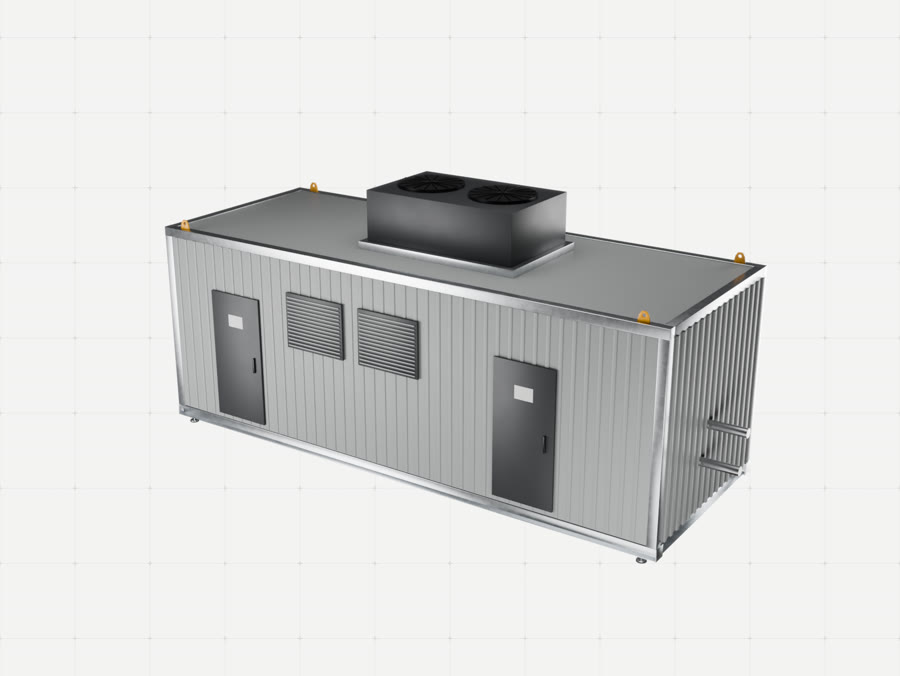
- Steel enclosures and modules
- Enclosed steel modules built to your dimensions when an open skid is not enough.
Proposed range. The scope is confirmed in the quote.
How we work