01
What a CDU is
CDU stands for coolant distribution unit. It stands between the building's cooling water and the liquid that cools the IT equipment. It moves heat from one to the other, and the two liquids never mix.
The building side is called the facility water system, or the primary loop. The IT side is called the technology cooling system, or the secondary loop. The two loops meet in the CDU, across a heat exchanger.
The unit also runs the secondary loop. It pumps the coolant out to the racks and back, holds the supply temperature, and keeps the pressure, the flow and the cleanliness within what the servers accept.
02
What a CDU serves
Air alone cannot carry the heat away from the densest racks. Liquid can, and every liquid-cooled system needs a unit that runs its loop.
- Direct-to-chip
- Cold plates sit on the processors and take the heat straight into the coolant.
- Rear-door heat exchangers
- A coil in the back door of the rack cools the air as it leaves the servers.
- Immersion tanks
- Servers stand in a bath of dielectric fluid, and the fluid gives its heat to a water loop.
03
Why the two loops are kept apart
It would be simpler to send facility water straight to the servers. Four things speak against it.
- Cleanliness
- Cold plates have very narrow channels. The secondary loop is a small, closed volume of treated coolant that can be kept clean. Facility water runs through long pipe runs and large plant, and cannot be held to that standard.
- Temperature
- Coolant that is colder than the dew point of the room makes water condense on pipes and servers. The CDU holds the supply temperature above the dew point, whatever the facility water is at.
- Pressure
- Facility water can be at a pressure the IT equipment is not built for. The secondary loop runs at its own pressure.
- Volume
- A leak in the secondary loop can only release the coolant in that loop, not the water of the whole building.
04
What is inside a CDU
Makes and sizes differ, but most liquid-to-liquid units hold the same parts.
- Heat exchanger
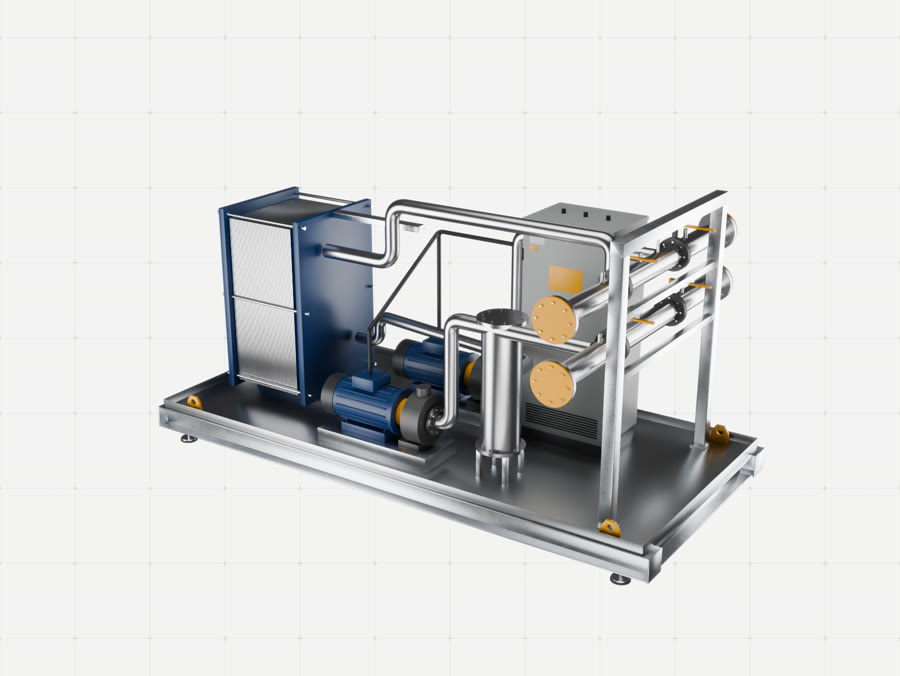
- Usually a plate heat exchanger. Facility water flows on one side of the plates and coolant on the other.
- Pumps
- Circulate the coolant to the racks and back. There are usually two or more, so one can stop while the unit keeps running.
- Control valve
- Sets how much facility water passes through the heat exchanger. This is how the unit holds the supply temperature.
- Filters
- Catch particles before they reach the cold plates. They are often doubled, so one can be changed while the other is in use.
- Expansion tank
- Takes up the change in coolant volume as the temperature changes.
- Sensors and controls
- Temperature, pressure, flow and leak detection, with a controller that runs the pumps and the valve and reports to the building's control system.
05
Types of CDU
CDUs are sorted in two ways: by where the heat goes, and by where the unit stands.
- Liquid-to-liquid
- Gives the heat to facility water through a heat exchanger. The usual choice where the building has a water loop.
- Liquid-to-air
- Gives the heat to the air in the room through a coil and fans. Used where there is no facility water.
- In-rack
- Mounted in the rack it serves.
- In-row
- A cabinet in the row or at the end of it, serving several racks through a manifold.
- Facility
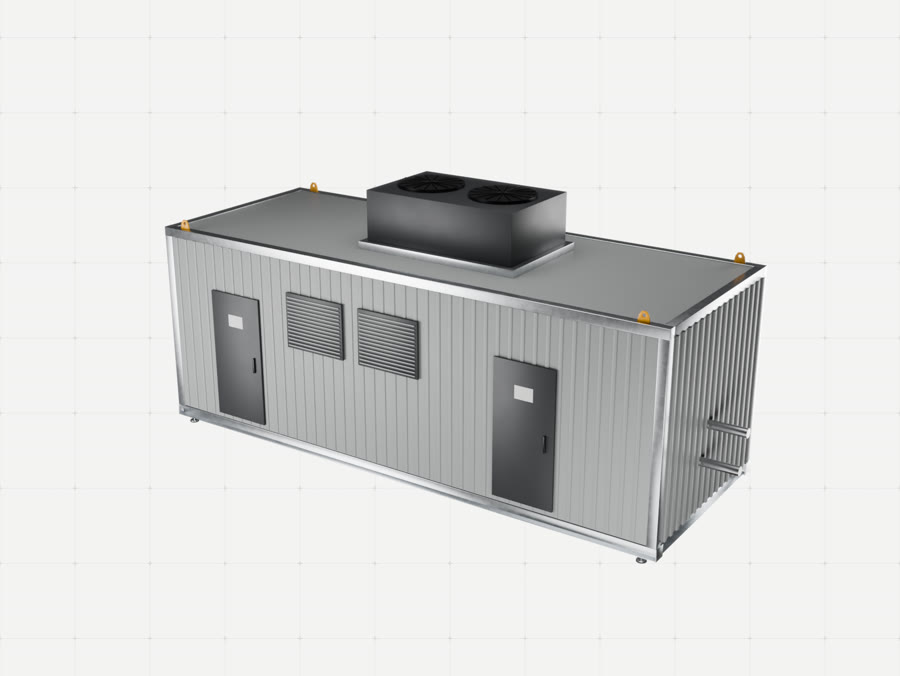
- A large unit in a gallery or a plant room, serving a whole hall through pipework. At this size the unit is built on a steel frame, and is often called a skid-based CDU.
06
The CDU skid
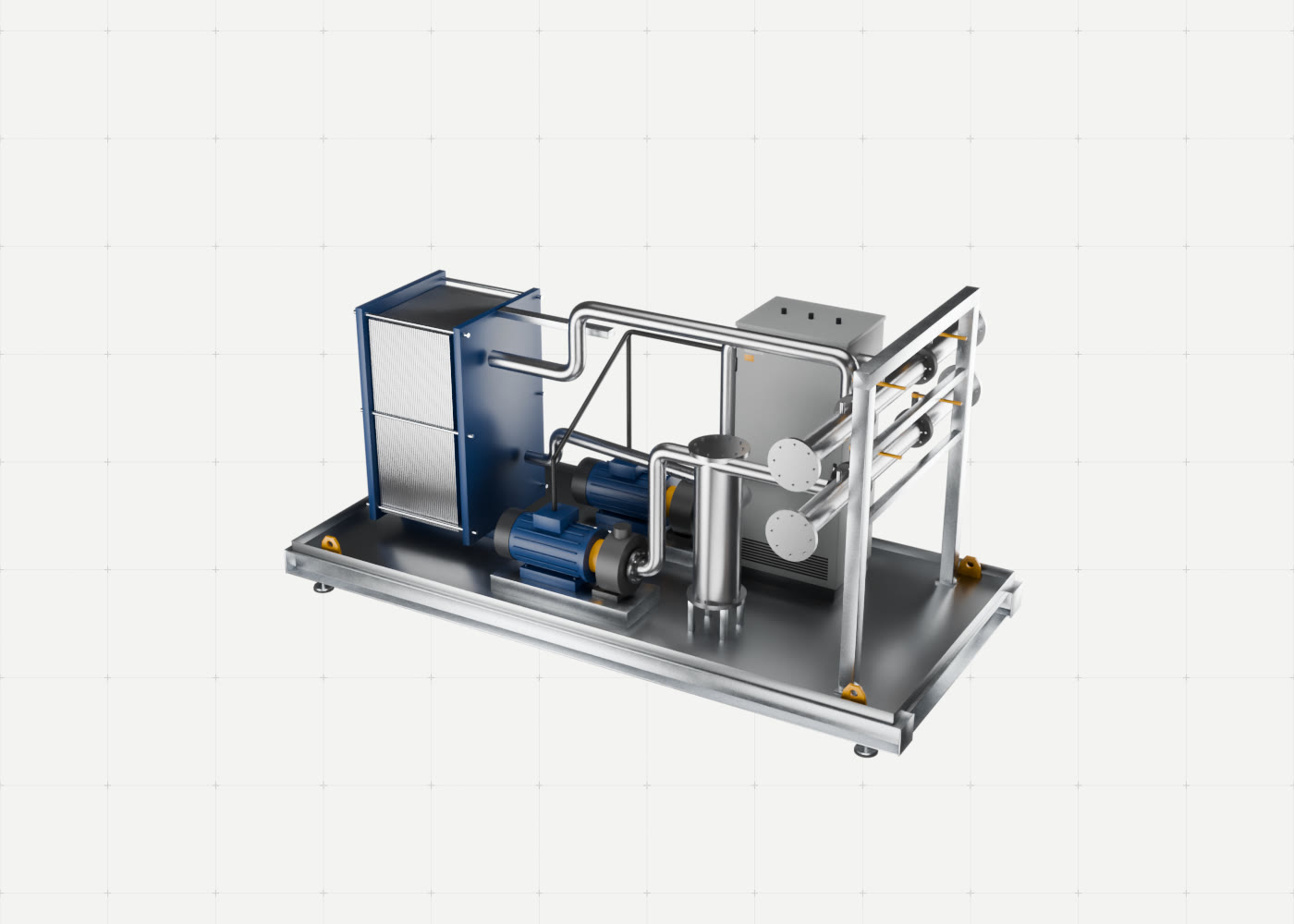
The larger units, and the pump and heat exchanger sets around them, are built on a steel base frame. Pumps, heat exchanger, valves and pipework are mounted and aligned in a shop, and the whole assembly is shipped, lifted and set as one unit. That frame is the CDU skid.
Equipment makers supply the unit. A steel fabricator supplies the frame, built to the unit's drawings. The frame carries a system that is full of liquid and running, and it has to do so on the road, in the lift and for the life of the plant.
- Filled weight
- The system weighs more full than empty. The frame, the lifting lugs and the pad are sized for the filled weight.
- Vibration
- Pumps and motors turn. The frame is made stiff enough that it does not resonate near the running speed.
- Alignment
- Shaft alignment and flange positions are set in the shop and must still be right after transport.
- Containment
- A tray under the wet end collects a leak before it reaches the floor of the data hall.
- Leveling and anchoring
- The frame is set true on its pad and bolted down at points the foundation designer has agreed to.
07
What to settle before the frame is built
The unit and the frame are designed by different people. These five points are worth settling before fabrication starts.
- Weights
- Dry and filled weight of each item, from the equipment maker's drawings.
- Connections
- Position and size of every flange where site pipework meets the skid.
- Place
- Where the unit stands, what it stands on, and the way in.
- Service access
- Which sides must stay open for filters, pump seals and the heat exchanger.
- Scope
- Steel only, or with equipment mounted, piped and tested.